A worked example — a two-column spread footing
Two columns 7 m apart stand on one 12 m spread footing. Between them the footing works like a deep beam turned upside down, carrying the ground pressure back up to the columns. This is Example 2.4 of the AStrutTie 2020 Technical Book, opened as a built-in example in the current AStrutTie and checked under ACI 318-25: every check value the book prints comes out the same, and the model the template builds is set beside the book's final one.
Problem data and check values are from the AStrutTie 2020 Technical Book, Example 02-2.4 (two-column spread foundation, ACI 318-19). The example ships with the app; the model and every check below were run in the current AStrutTie under ACI 318-25.
Given
- f′c = 24 MPa, the value the Technical Book's check tables use (its text gives 30 MPa) · fy = 400 MPa · φ = 0.75
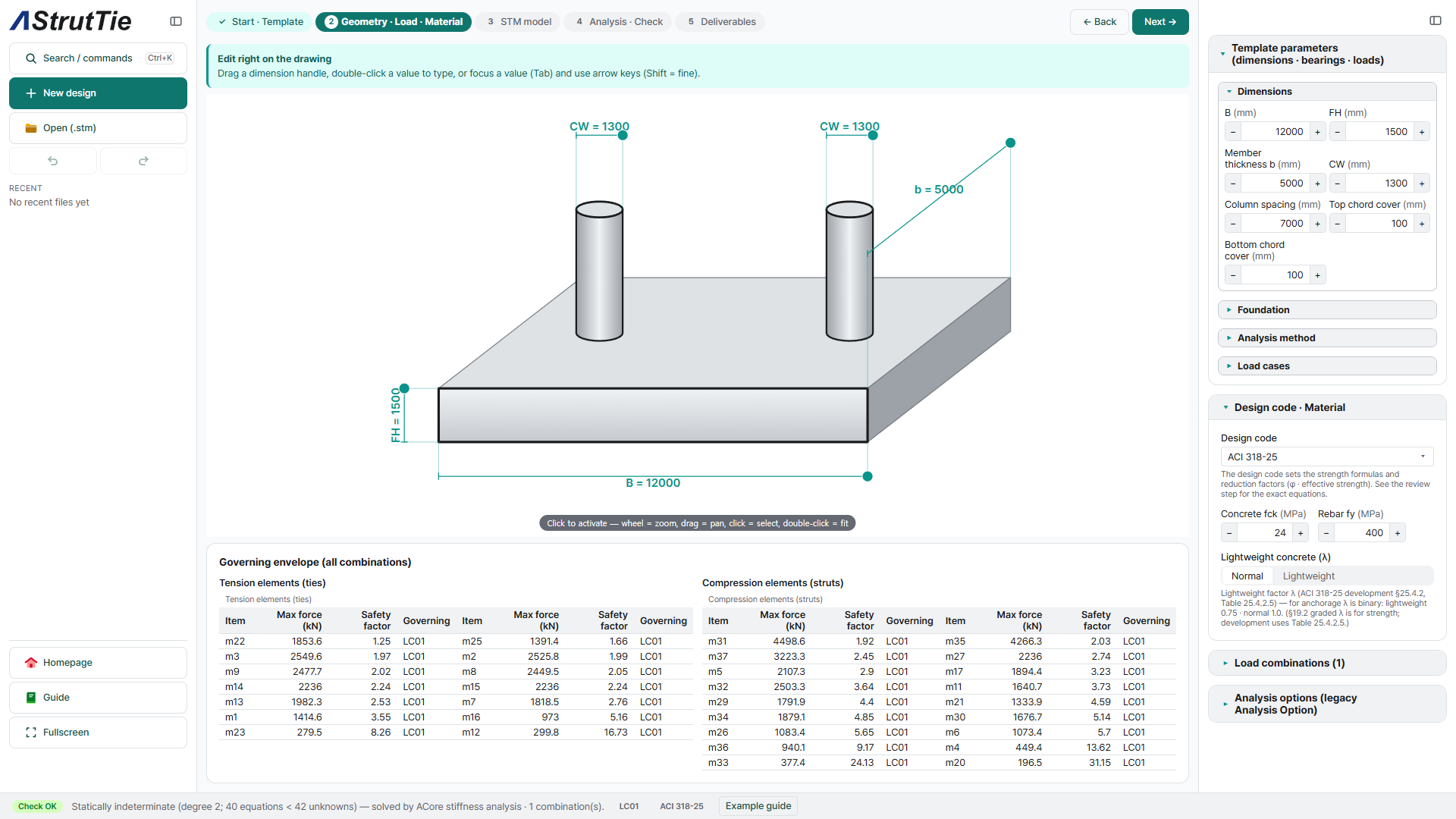
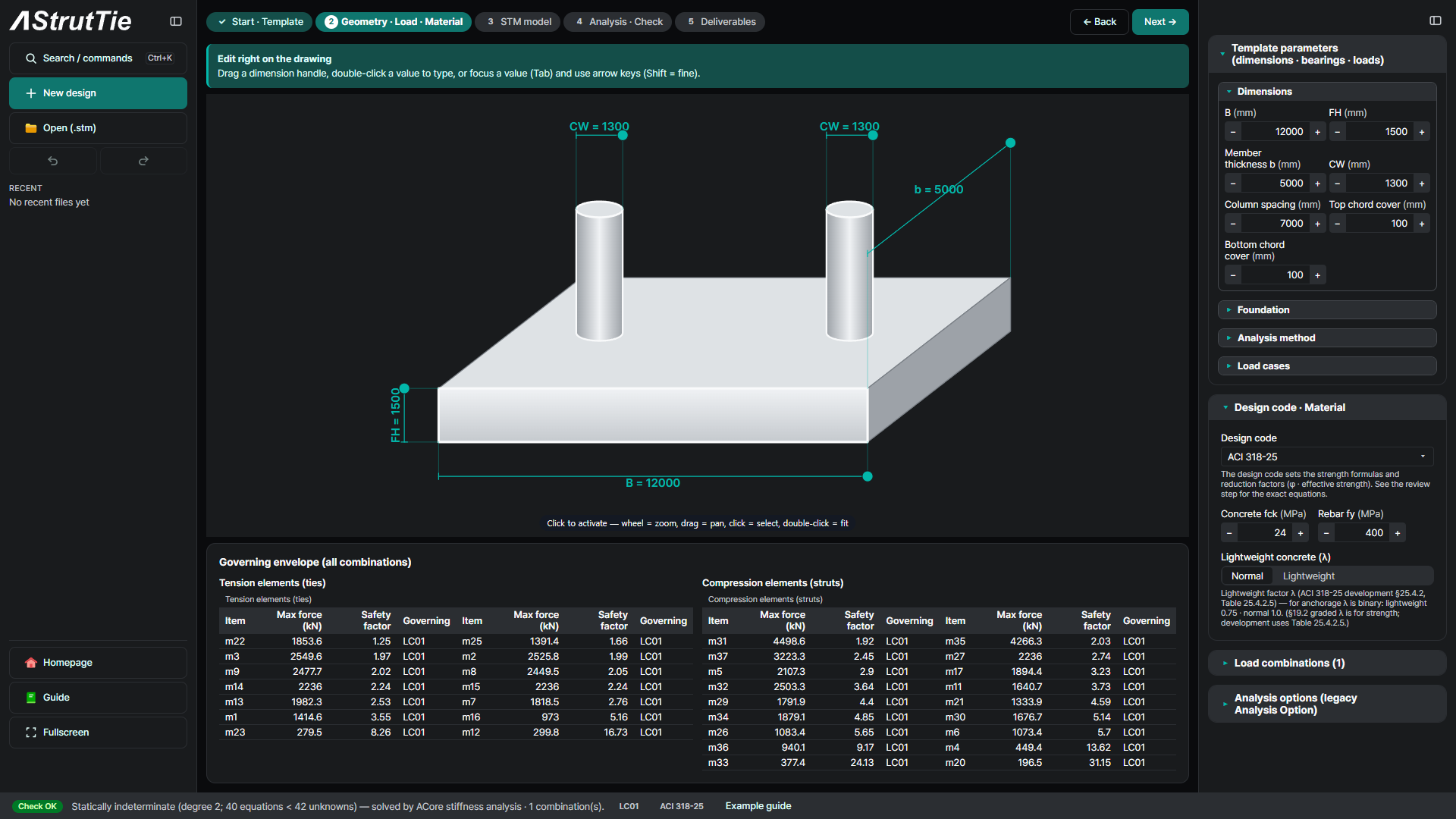
- Footing 12,000 × 5,000 mm, 1,500 mm thick · two columns 1,300 × 1,300 mm, 7,000 mm apart
- Load case L1 (column 1): V = 8,500 kN · H = 120 kN · M = 5,500 kN·m · L2 (column 2): V = 8,000 kN · H = 130 kN · M = 6,000 kN·m · combination LC01 = L1 + L2
- Ground springs, vertical modulus 30,000 kN/m² · bars top and bottom 33-#8 · shear bars #6, 7 legs @ 300 mm vertical and 6 bars @ 300 mm horizontal
The problem
Two columns, two load cases: column 1 brings 8,500 kN with 120 kN and 5,500 kN·m, column 2 brings 8,000 kN with 130 kN and 6,000 kN·m, and the combination adds them. The ground answers through springs, so the pressure under the footing is not uniform. The Technical Book example opens in AStrutTie with its dimensions, loads, materials and bars already entered in the two-column spread-footing template.
Build the model — the template's truss
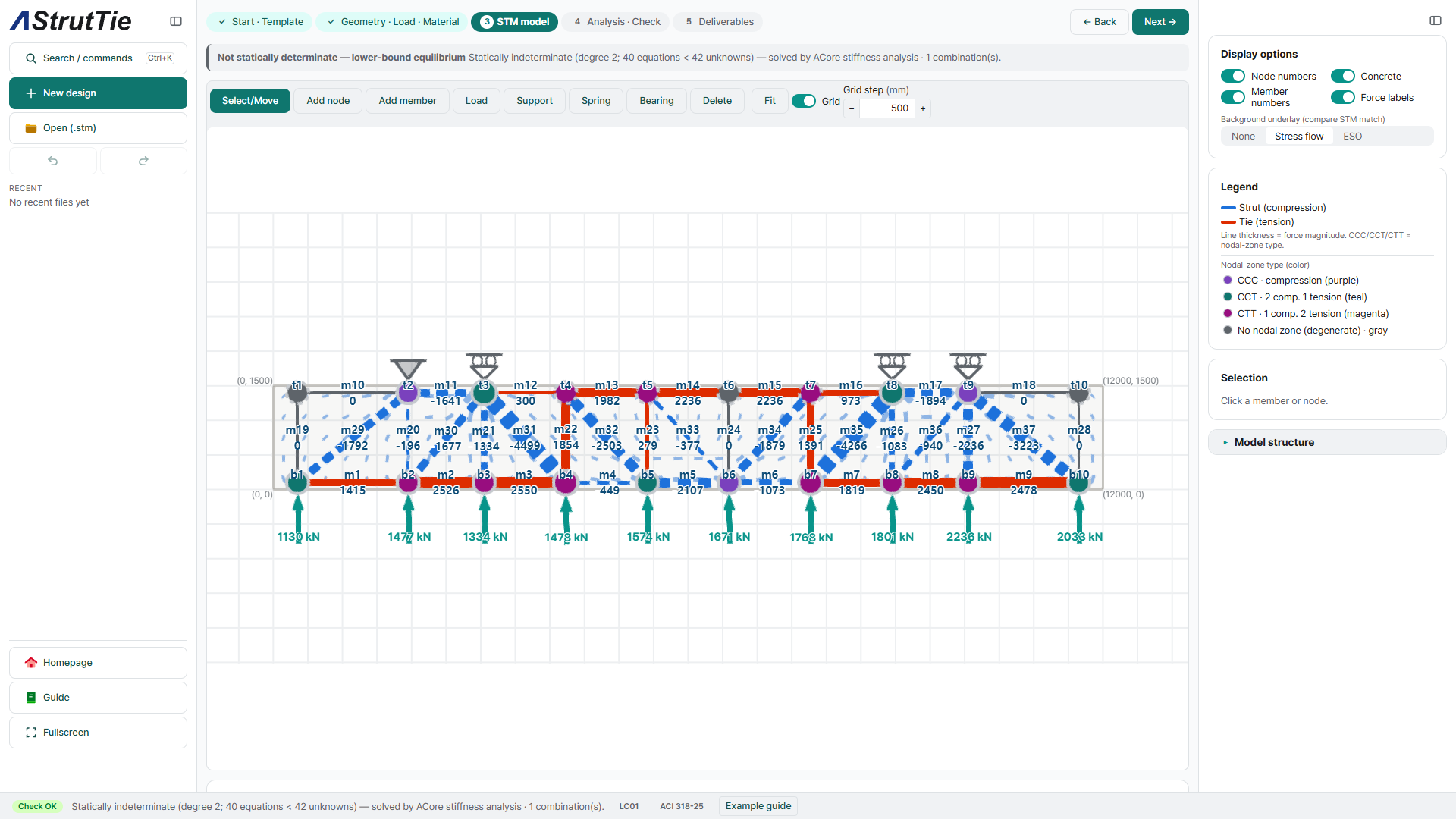
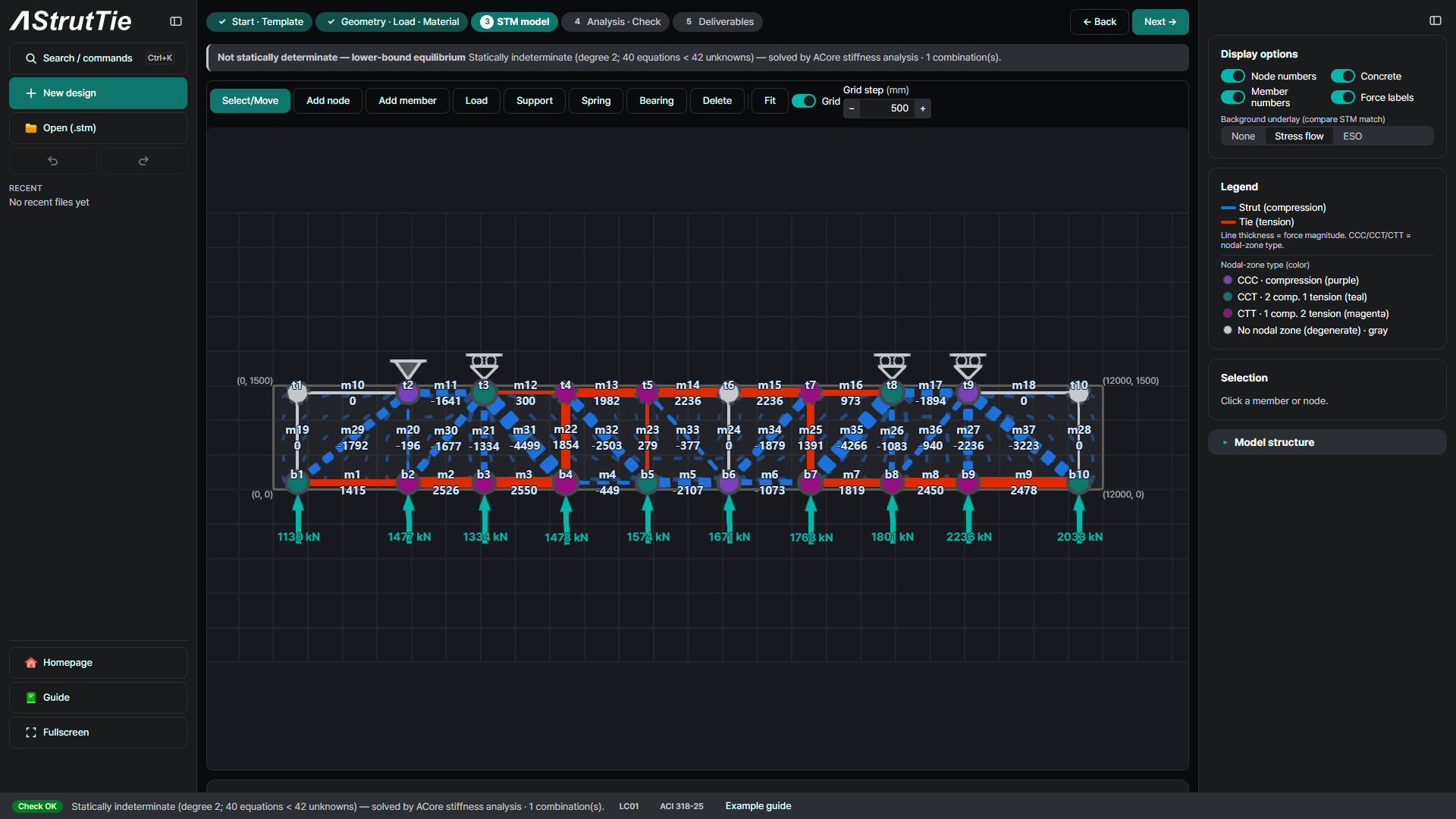
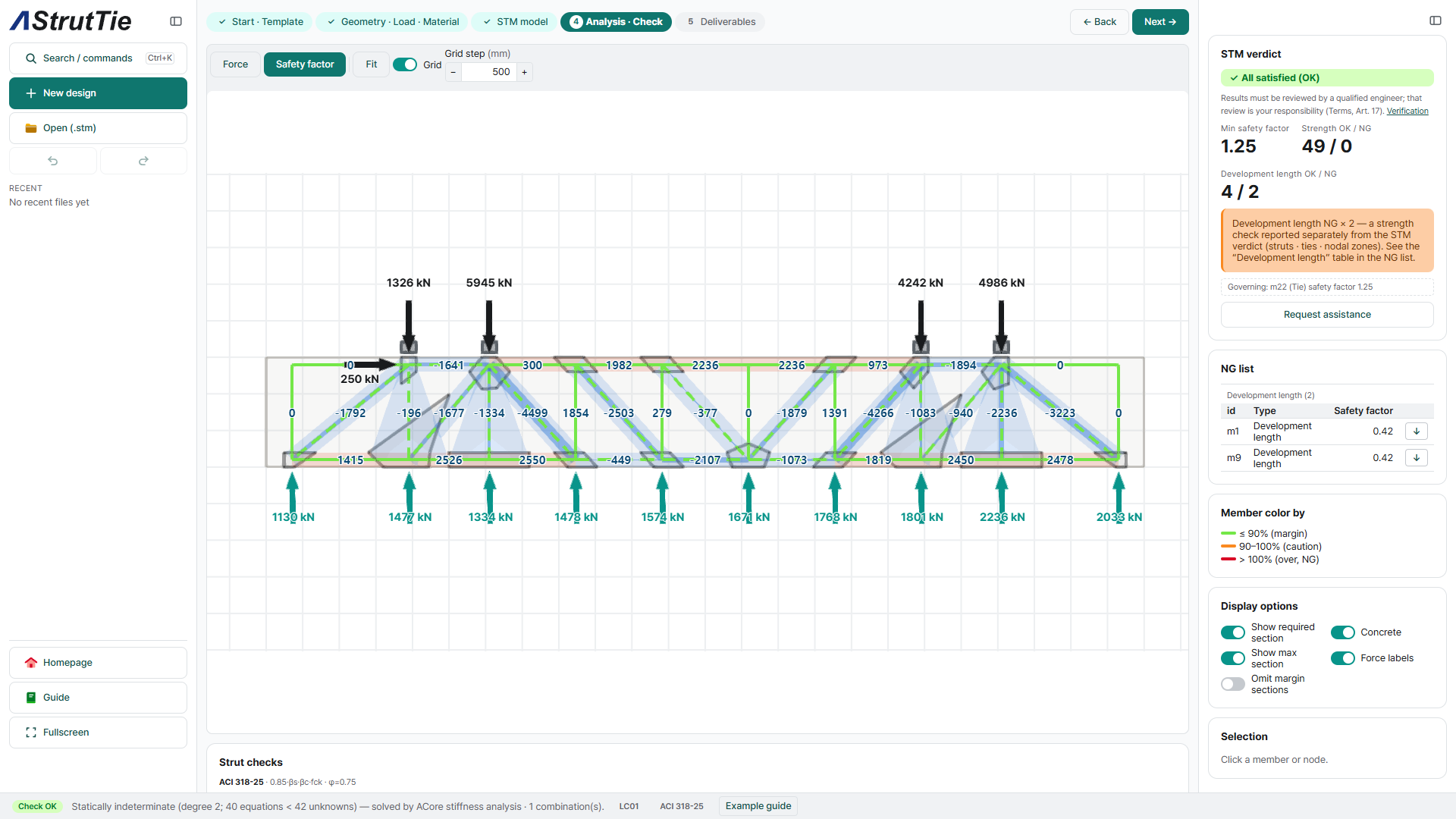
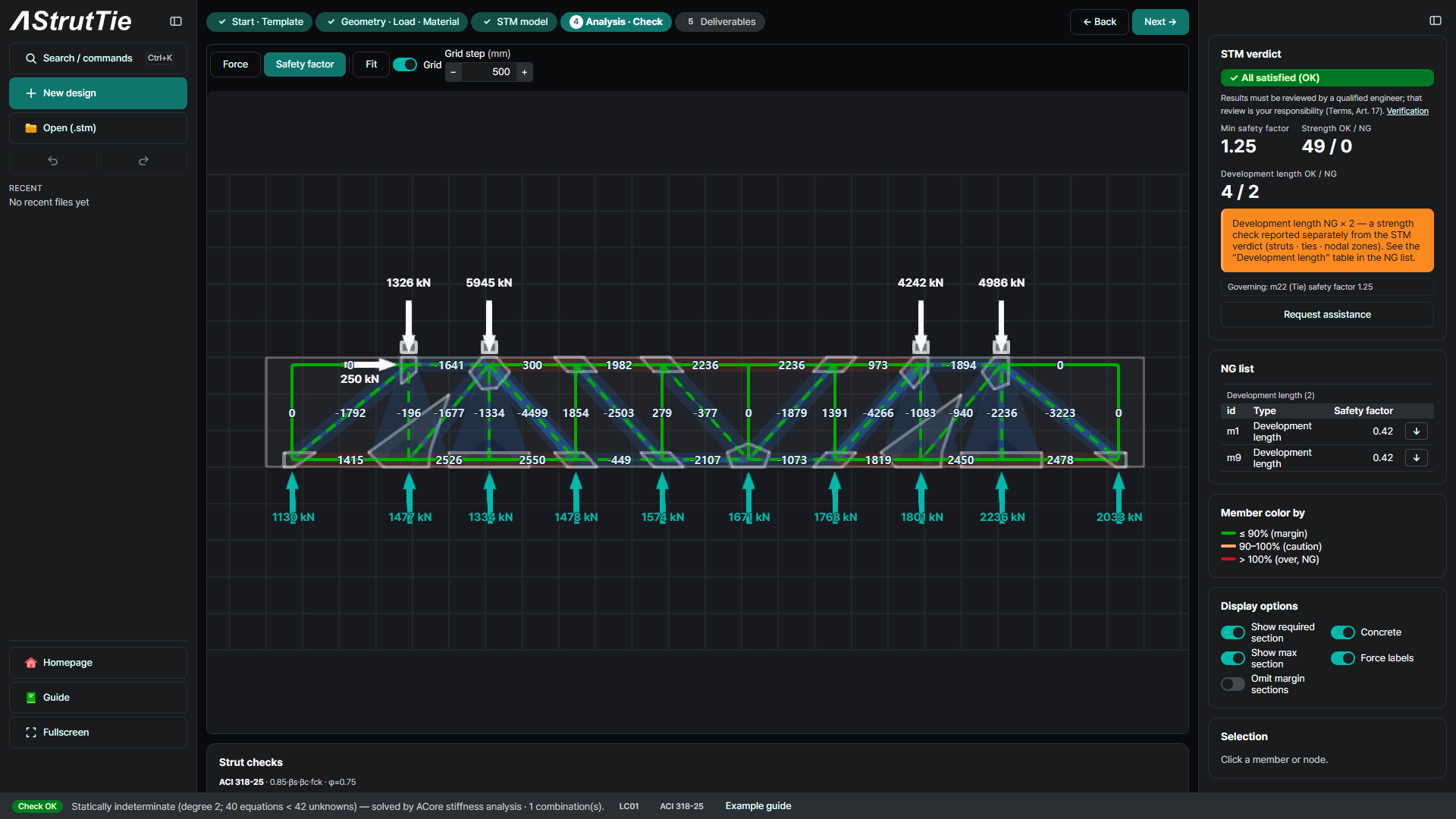
The template puts the top chord 100 mm below the top and the bottom chord 100 mm above the bottom, with two nodes under each column and a vertical at every node: 20 nodes and 37 members. As in the Technical Book, the columns are the supports and the ground pressure comes in as loads along the bottom chord. With the springs the truss is statically indeterminate to the second degree, so the app solves it by stiffness analysis. The book's final model, refined by its optimized analysis, has 24 nodes and 45 elements, so the member forces differ: the largest bottom-chord tension is 2,549.6 kN here against the book's 2,535.4 kN (+0.6%), and the largest compression is 4,498.6 kN in diagonal m31 against 4,844.4 kN in the book's top chord (−7.1%).
Analyze & check — every member, every node
49 of 49 strength checks pass. The minimum safety factor is 1.25, on the vertical tie m22 near column 1, which the #6 shear bars carry. Anchorage is reported separately from the strength verdict, and the two ends of the bottom tie fail it; step ⑦ explains why.
Tie check — required reinforcement
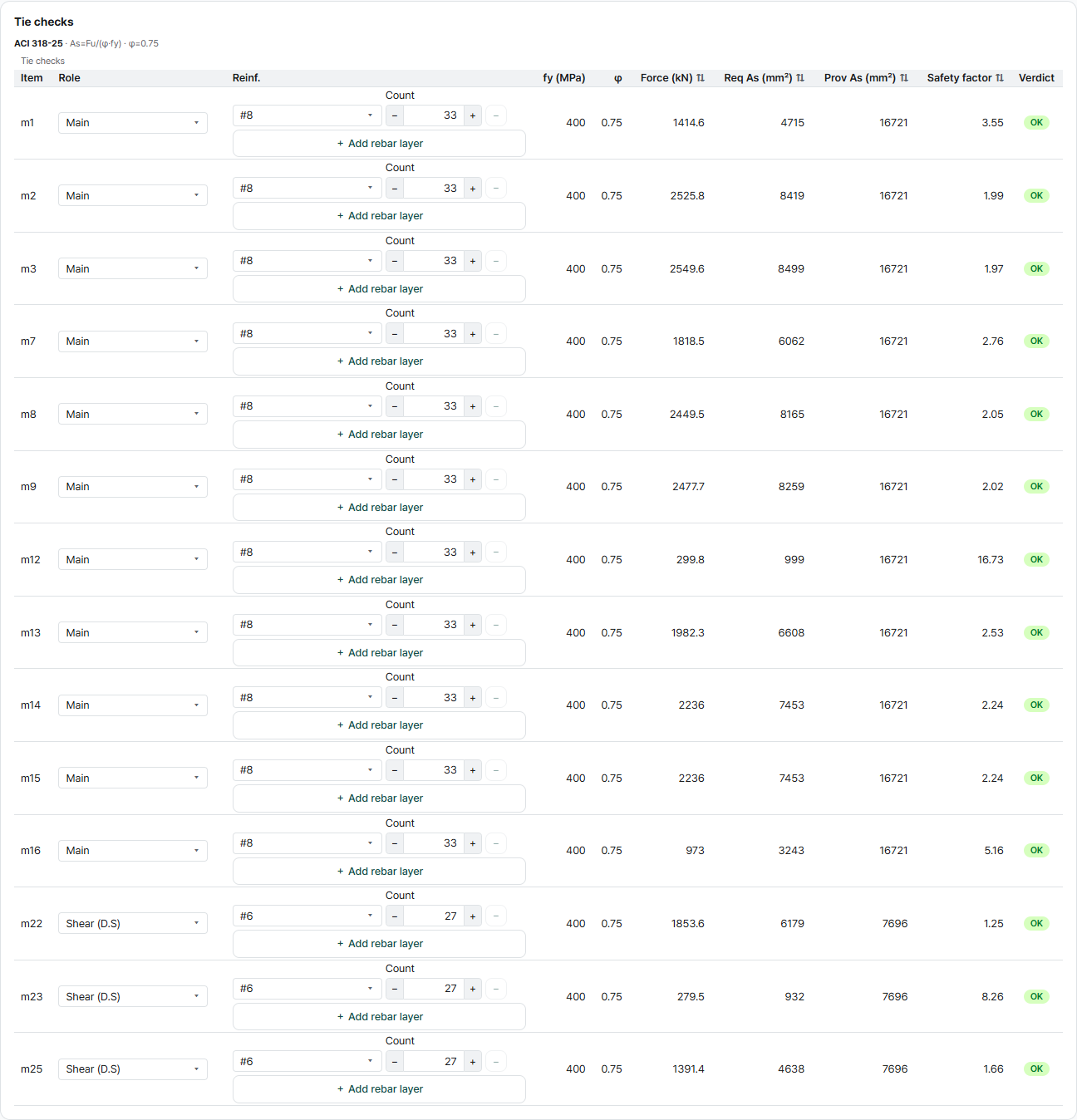
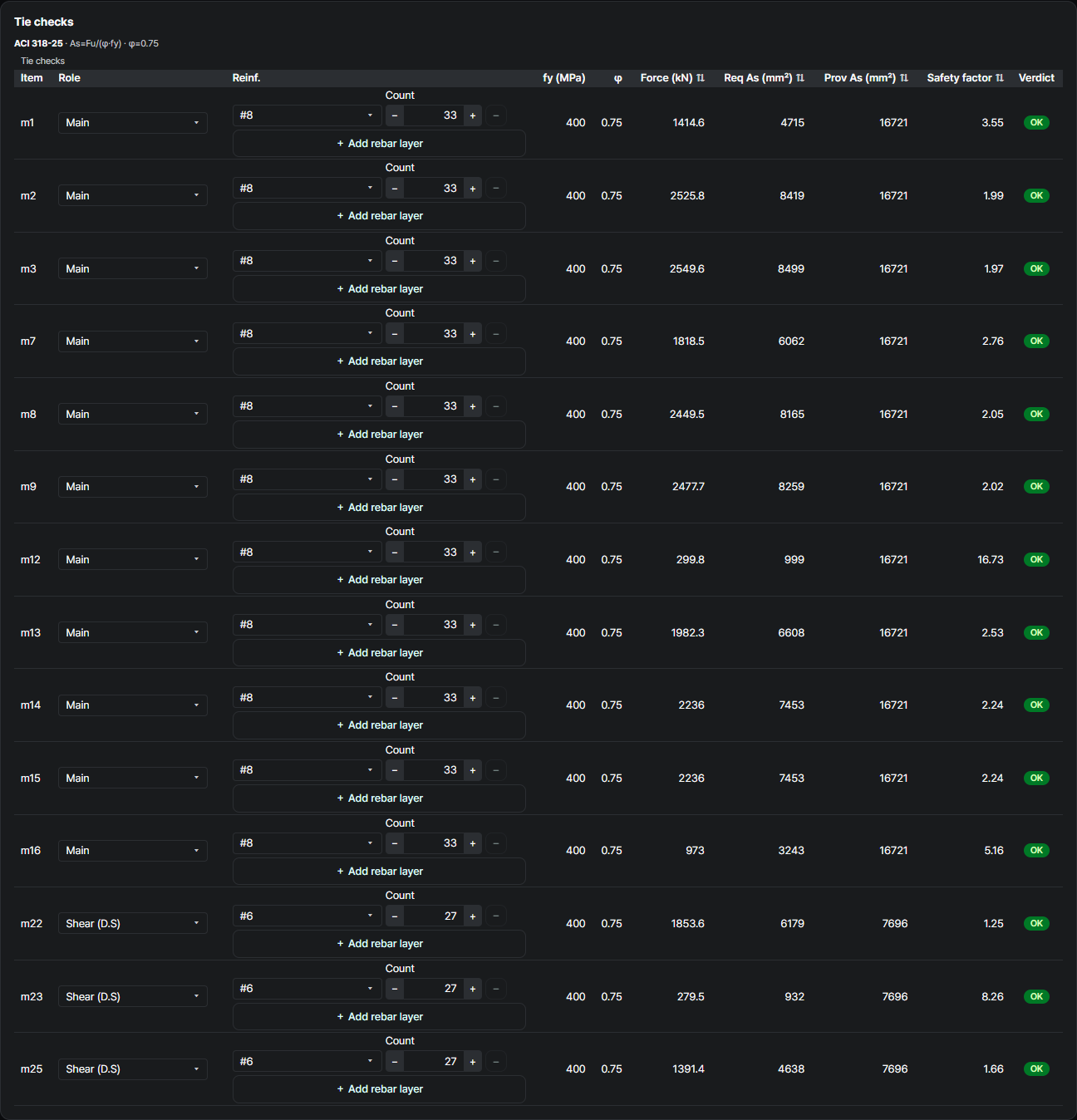
ACI 318-25Under and beyond the columns the bottom chord is in tension, up to 2,549.6 kN in m3, which needs 8,499 mm²; 33-#8 give 16,721 mm² (1.97). Between the columns the footing bends the other way and the top chord takes the tension, up to 2,236 kN in m14 and m15. The vertical ties are the shear reinforcement: m22 carries 1,853.6 kN against 27 legs of #6 within its effective width, 7,696 mm² (1.25). The tie checks the book prints, such as T45 at 2,535.40 kN needing 8,451.34 mm², come out the same in the app's comparison.
Strut check — effective strength & width
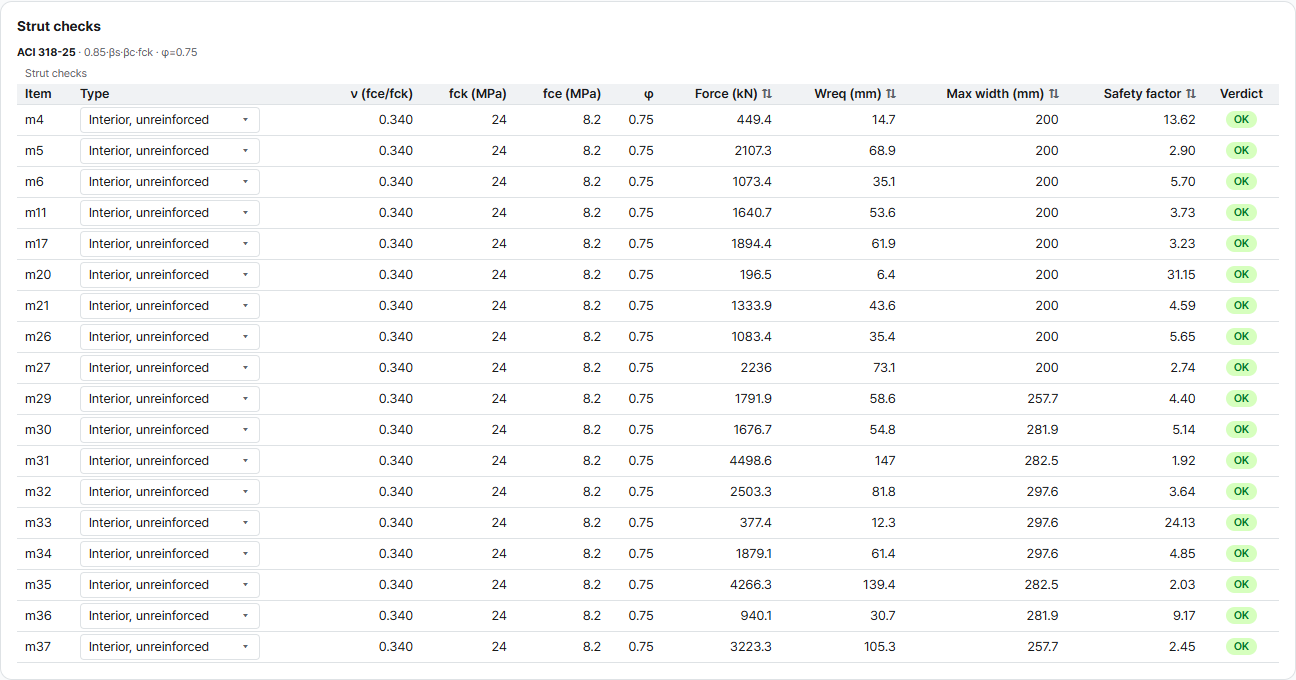
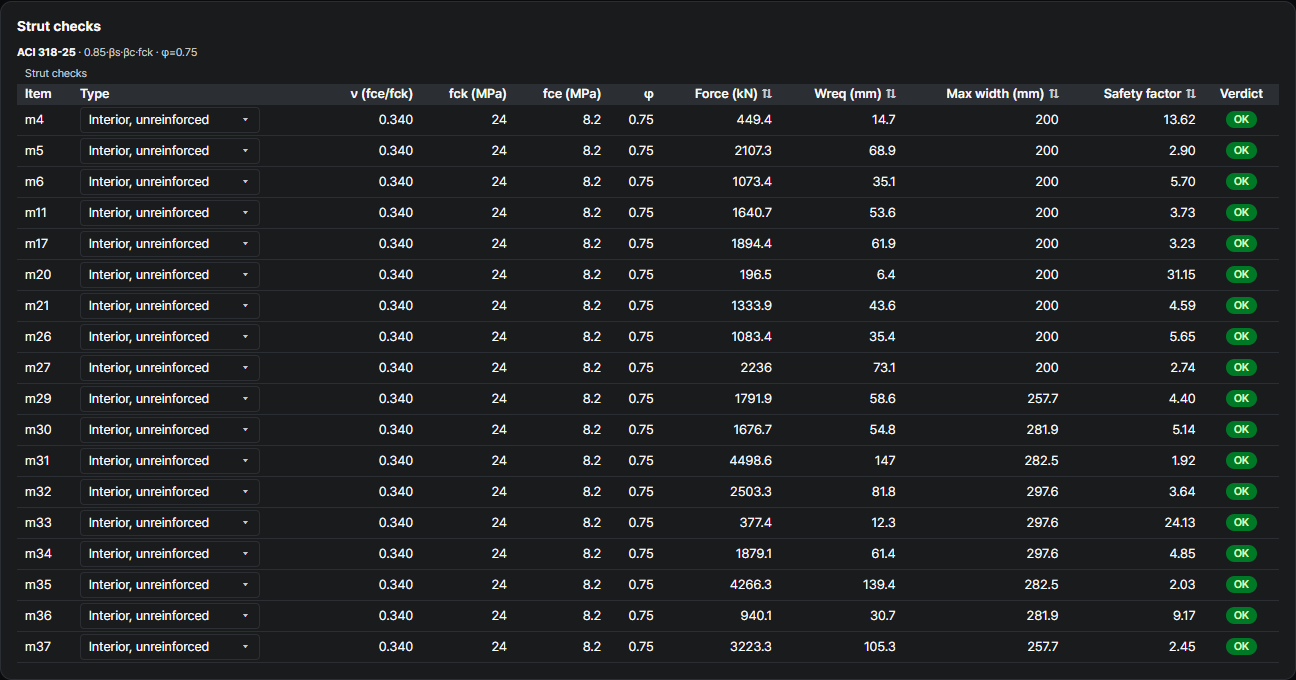
ACI 318-25 §23.4 · §23.5The footing's shear bars, #6 at 300 mm both ways, give ρ ≈ 0.0013 vertically and 0.0011 horizontally, below the 0.0025 per direction that §23.5 asks for βs = 0.75. Every strut is therefore taken as βs = 0.40, as in the Technical Book: fce = 8.16 MPa. The template's default would be 0.75, which assumes reinforcement this footing does not have. The most loaded strut is the diagonal m31 from column 1, 4,498.6 kN, needing 147 mm of the 282.5 mm available (1.92).
Nodal-zone check — by node type
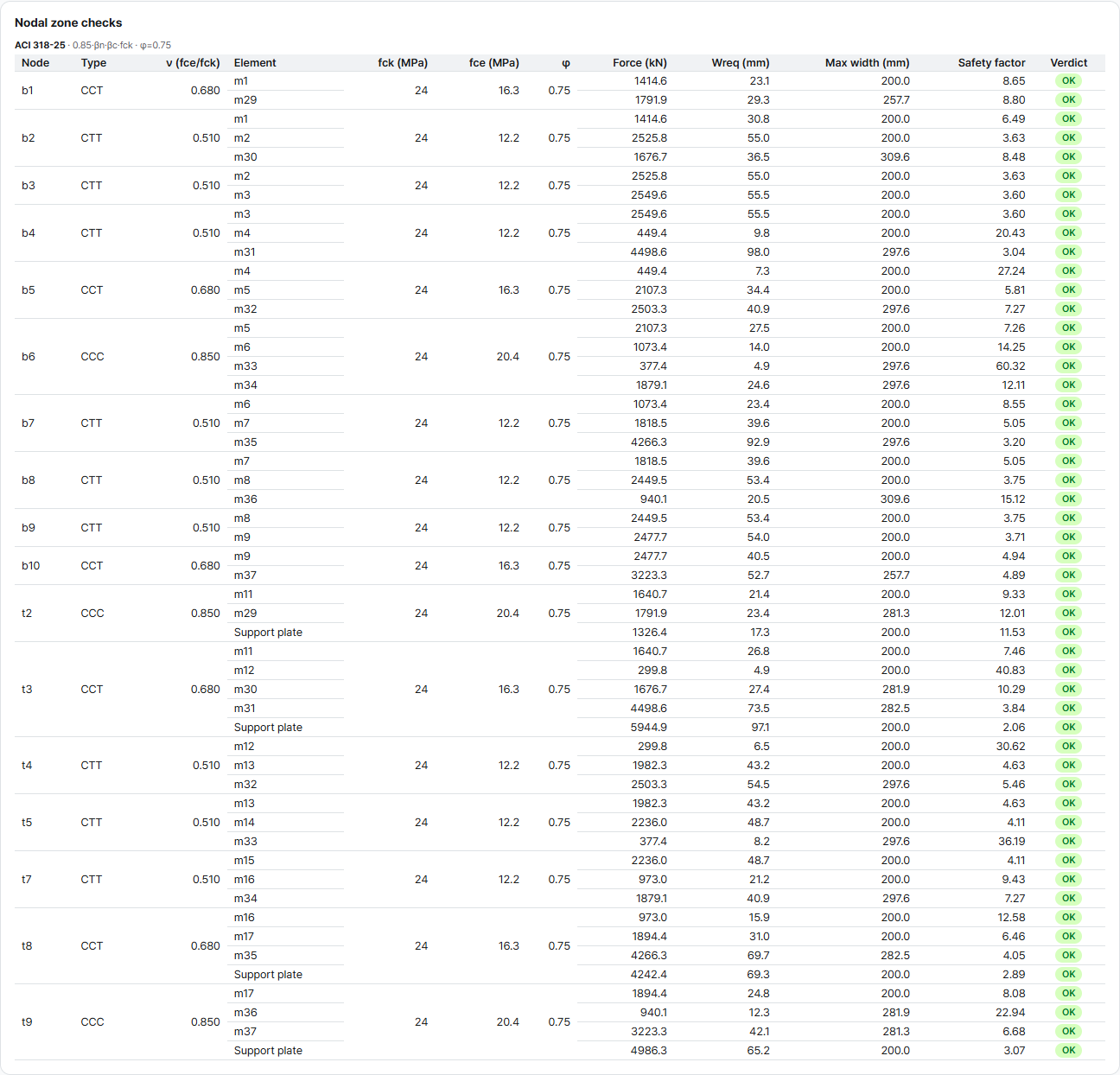
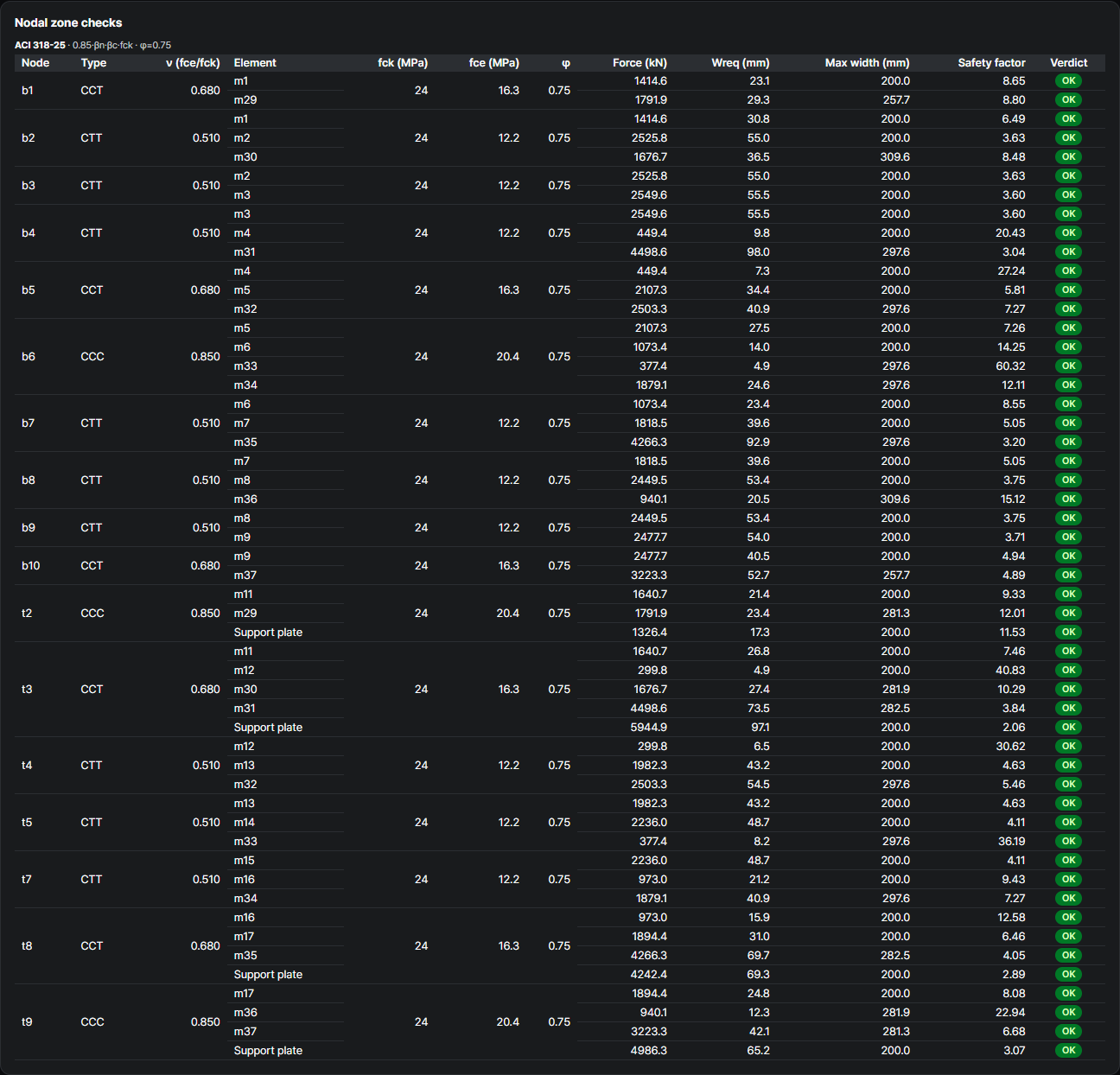
ACI 318-25The tightest node is t3, the inner support under column 1: its bearing face needs 97.1 of 200 mm (2.06). Where ties meet along the chords the nodes are CTT; b4, where the diagonal m31 lands, is the lowest at 3.04. The book's check of node N3, face C-3 with 4,050.0 kN needing 52.9 mm, is reproduced exactly in the app's comparison.
| Node | βn | fce (MPa) |
|---|---|---|
| CCC | 1.0 | 20.4 |
| CCT | 0.8 | 16.3 |
| CTT | 0.6 | 12.2 |
Development length check — the bar ends at the edge
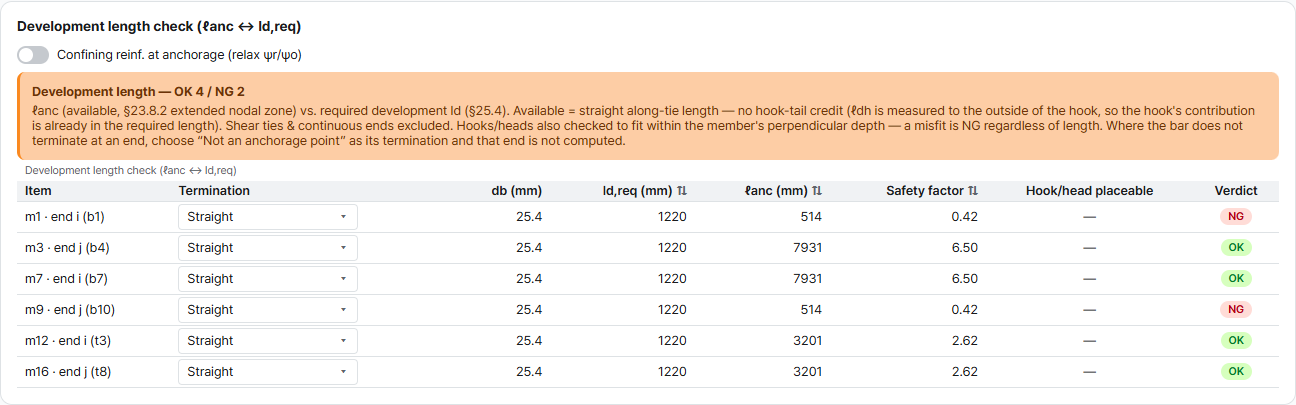
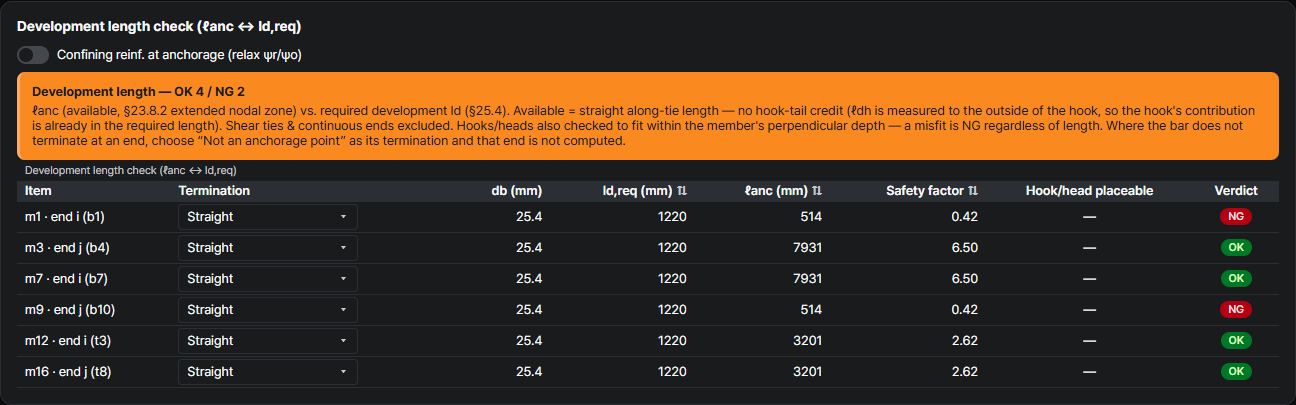
ACI 318-25 §23.8.2 · §25.4The bottom-chord bars end at nodes b1 and b10, 350 mm from the ends of the footing. Straight, a #8 bar needs ℓd = 1,220 mm; the extended nodal zone leaves 514 mm, a safety factor of 0.42. A hook would bring the requirement down to 753 mm, still more than 514 mm, because the node sits so close to the edge. The Technical Book's check tables for this example do not cover anchorage; the NG is shown as the app reports it.
What changes from the Technical Book
ACI 318-19 → ACI 318-25Same footing, same loads, same bars. The strength equations and φ are the same in both editions, so every value the book's check tables print comes out the same. What differs is the model — the template's truss against the book's optimized one — and two checks: the struts keep the book's βs = 0.40 because the footing lacks §23.5 reinforcement, and the app checks the anchorage of every tie end.
| Check | Technical Book (2020 · ACI 318-19) | This example — ACI 318-25 | Why |
|---|---|---|---|
| Values that must match (8) | T45 2,535.40 kN → 8,451.34 mm² · S9 4,844.4 kN → 158.3 mm · N3 C-3 4,050.0 kN → 52.9 mm … | 8 of 8 the same | Same strength equations and φ |
| Model | Final model after optimized analysis — 24 nodes · 45 elements | Template model — 20 nodes · 37 members · indeterminate (2) | The app starts from its template; the book refined its model |
| Largest bottom-chord tension | E45 2,535.4 kN | m3 2,549.6 kN (+0.6%) | Different model, same load path |
| Largest compression | E9 4,844.4 kN (top chord) | m31 4,498.6 kN (diagonal, −7.1%) | Different model |
| Bottom bars, 33-#8 | 16,721.39 mm² | 16,721 mm² · 1.97 at m3 | Same bars |
| Shear reinforcement | 7-#6 · weff 1,180.0 mm · φFn 2,354.3 kN ≥ 1,741.94 kN | m22 1,853.6 kN · 7,696 mm² (1.25) | Vertical ties at the template's positions |
| βs of the struts | 0.40 | 0.40 (template default 0.75) | #6 @ 300 mm gives ρ ≈ 0.0013 / 0.0011 < 0.0025 (§23.5) |
| f′c | 30 MPa in the text · 24 MPa in the check tables | 24 MPa | The app follows the tables (the book is inconsistent) |
| Anchorage of the end bars | Not in the check tables | 514 mm available < 1,220 mm required (0.42) — NG | The app checks every tie end |
These are the checks AStrutTie runs on every model — here on an example from the AStrutTie 2020 Technical Book, opened in the current app, with every check value the book prints reproduced and every difference traced to the model, a reinforcement detail or the book itself. How we verify →
Try it on your own numbers
Open AStrutTie in your browser, sign in with your email and start from the same template. The Free plan needs no installation and no card.