Strut-and-tie model design, verified.
AStrutTie designs the concrete members where ordinary beam theory doesn't apply — deep beams, corbels, pier caps, footings, frame corners — with a strut-and-tie model you can see, check, and hand to a reviewer.
- Strut — concrete compression
- Tie — reinforcement tension
- Nodal zone
- 29automated gate suites
- 2,356checks green
- 16D-region templates
- 5design codes
- ✓ Cross-verified against independent references — published ACI 318-19 hand calculations, SAP2000, and a from-scratch numpy oracle How we verify →
- ✓ Your AI know-how data stays yours — never used to train models for other customers Data policy →
Model selection, not strength checks
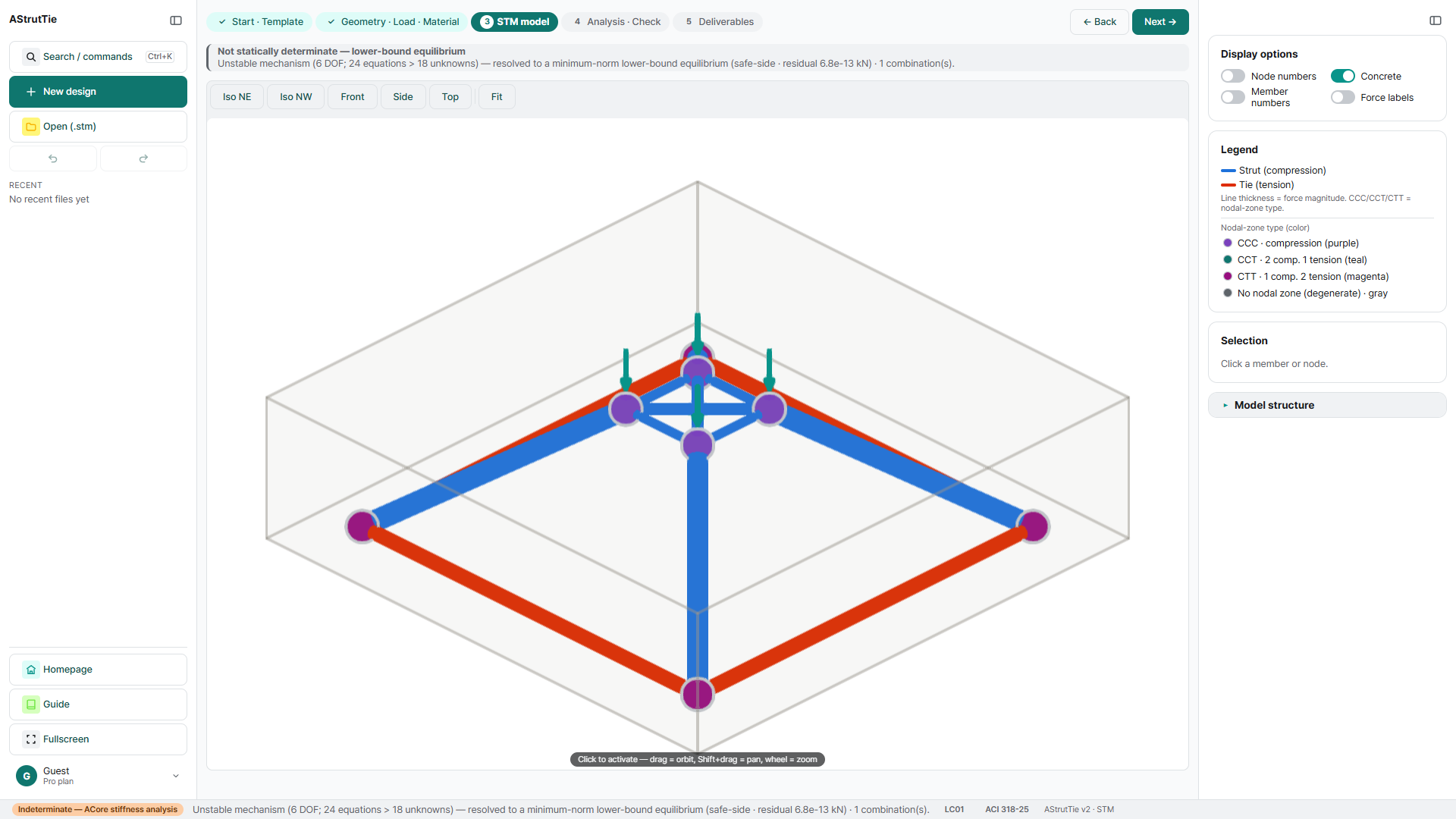
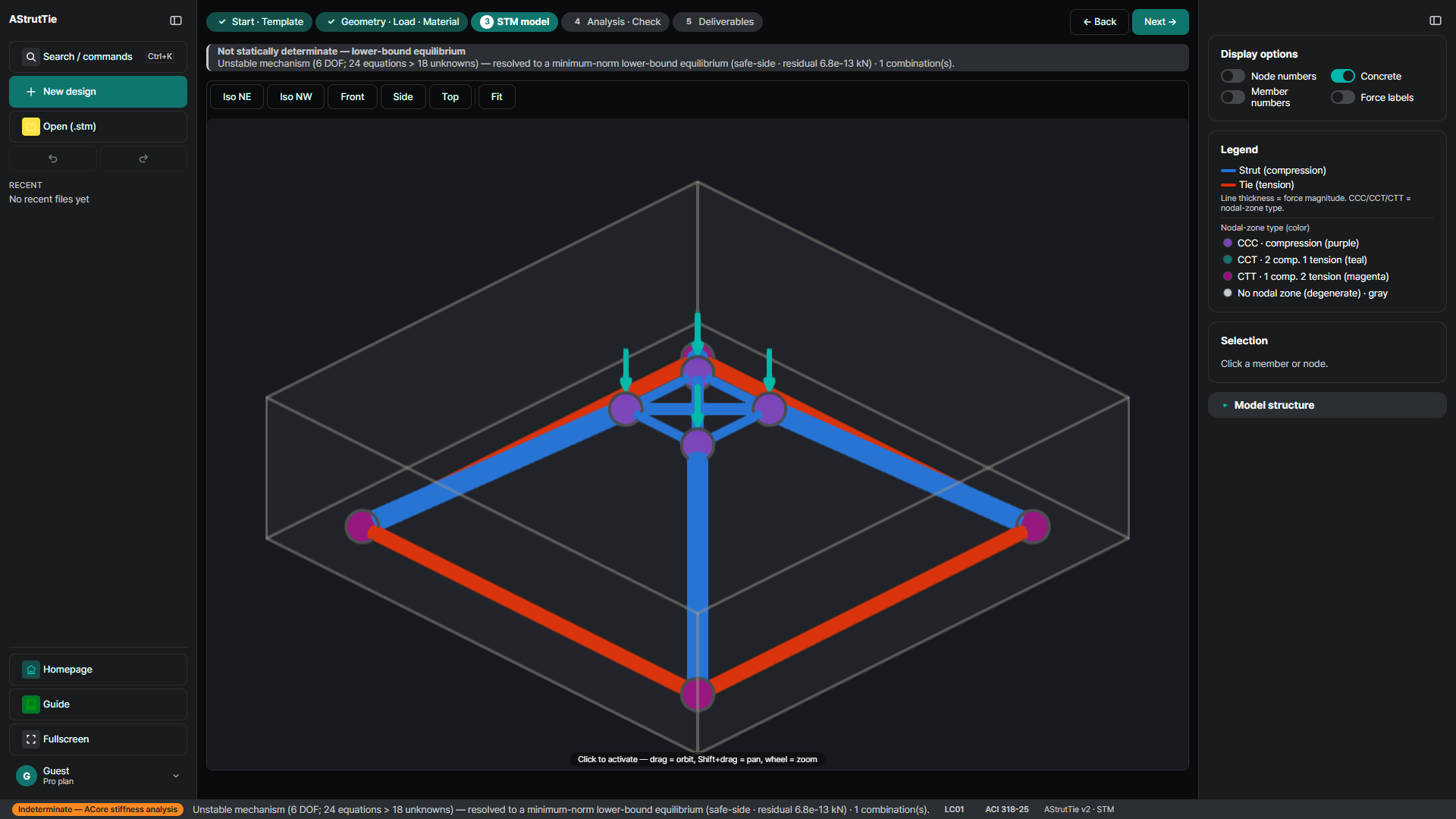
The essence of STM is the selection of the truss model that best represents the load path, yet that selection is not uniquely determined — it must satisfy equilibrium, ductility, serviceability and buildability at once, and the struts and ties must not deviate far from the elastic stress trajectories.
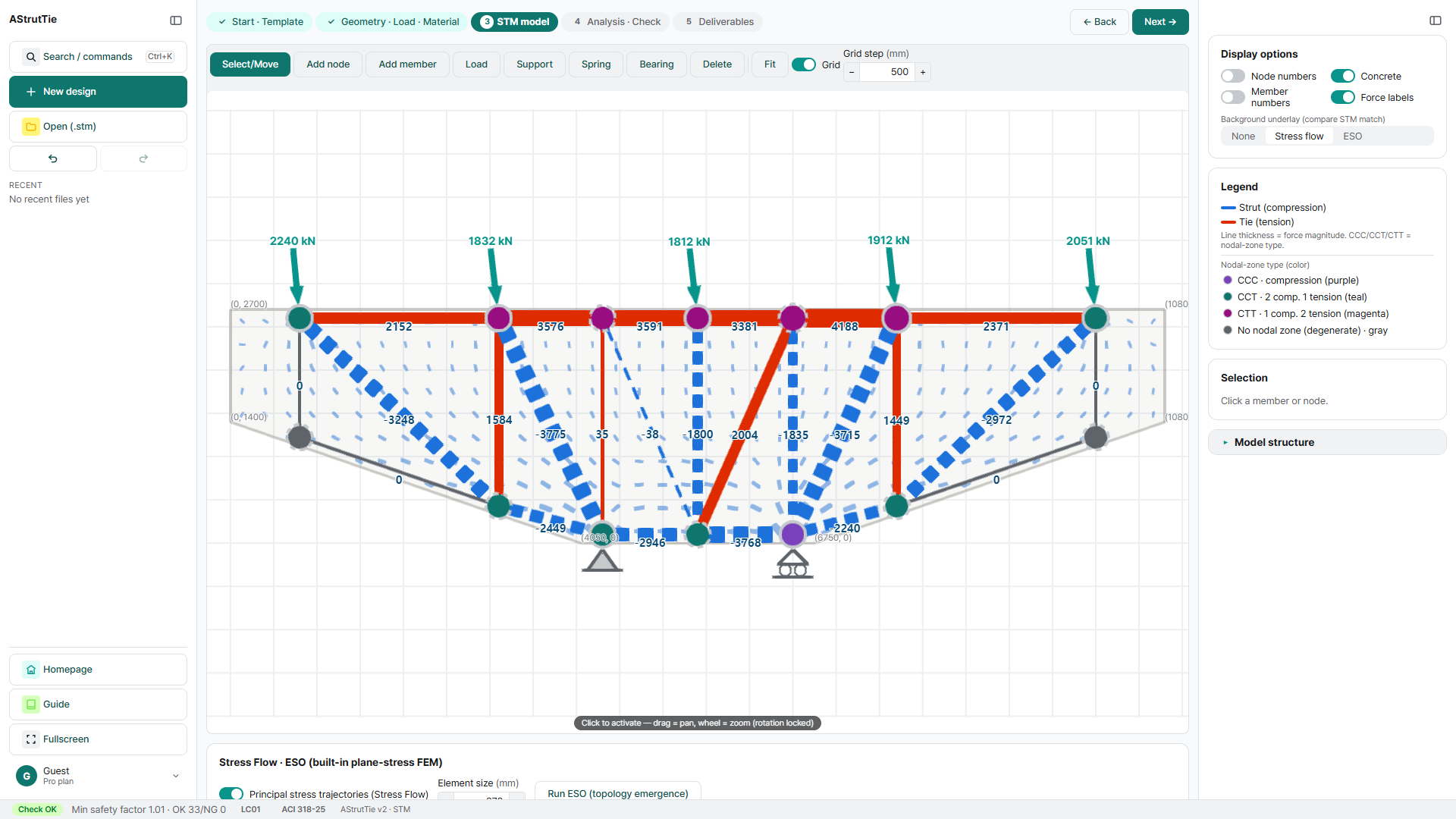
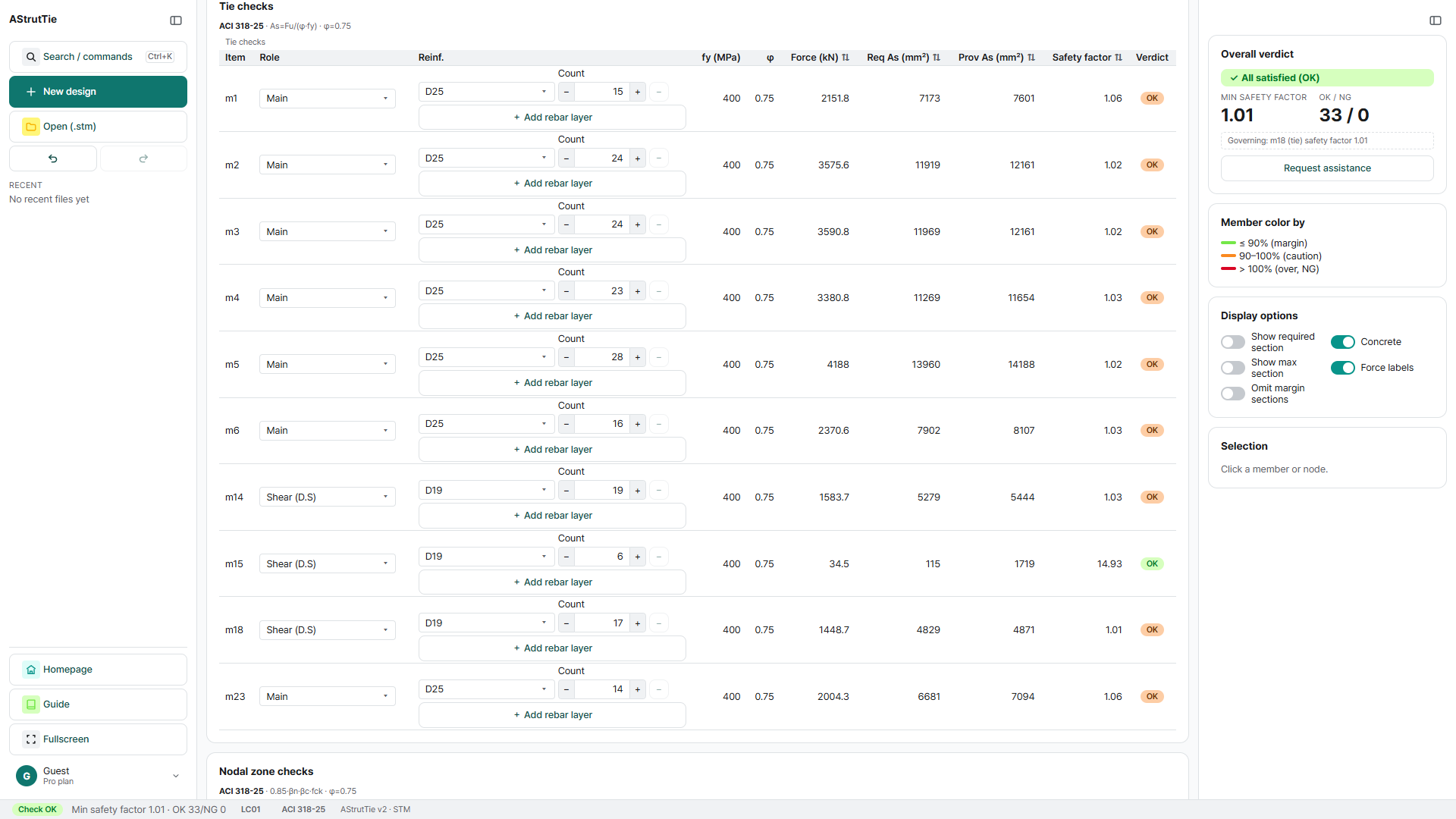
AStrutTie therefore provides guidance for selecting a truss model that follows the load path, based on the stress flow, and automatically re-performs the strength checks when the geometry or loads are changed.
Try it live
When the load is changed, member forces and required section areas update in real time.
See the product
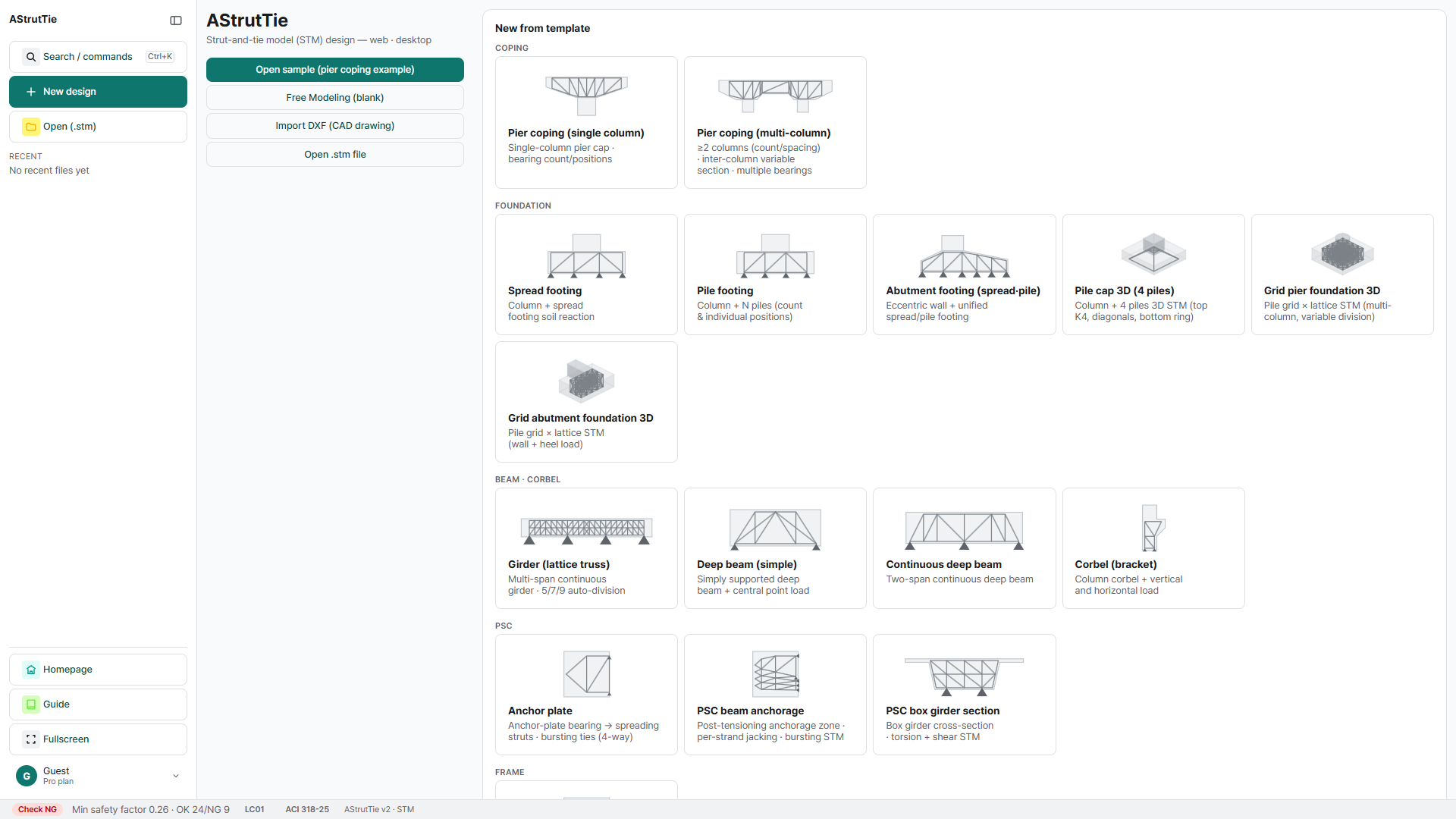
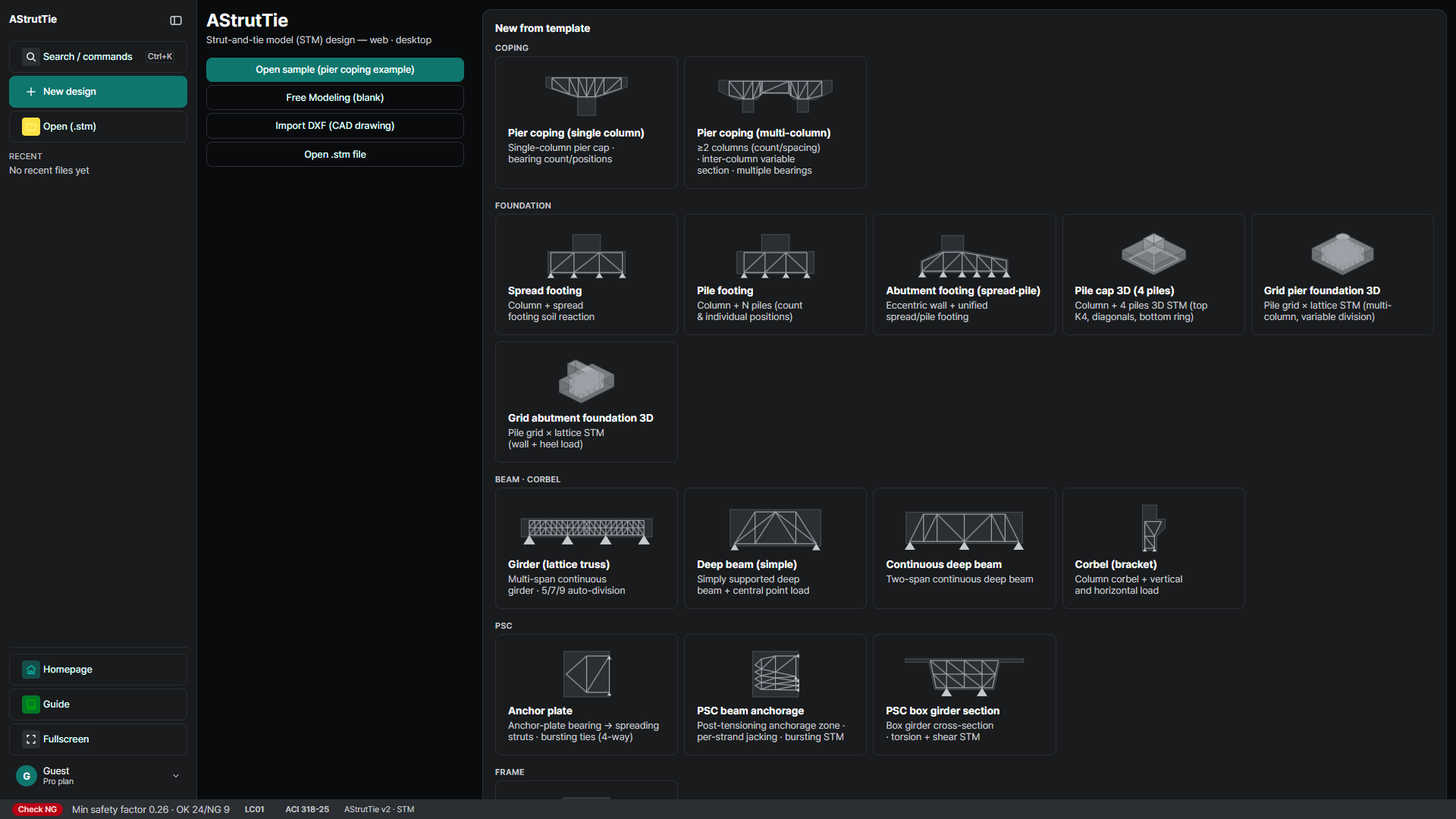
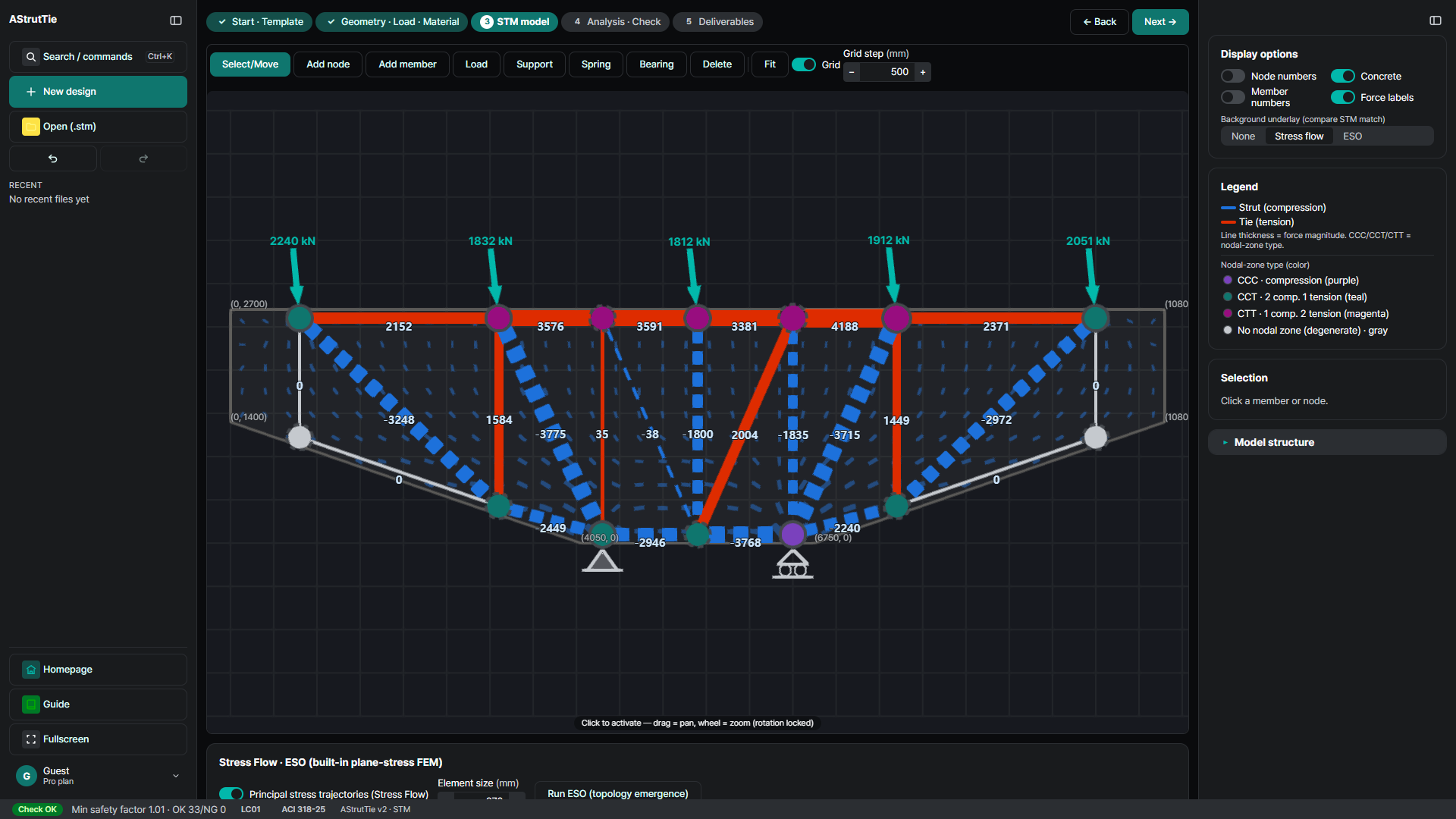
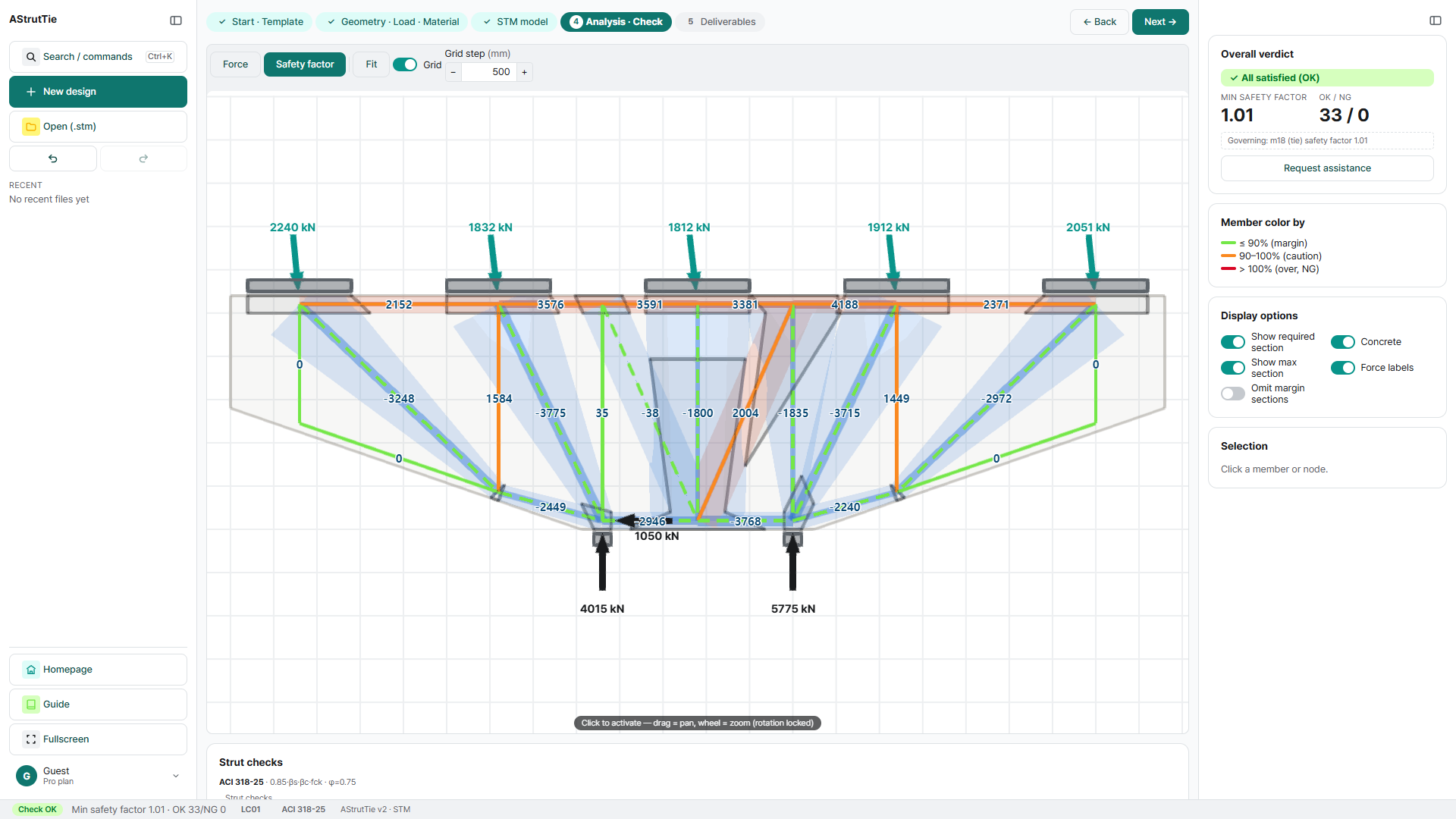
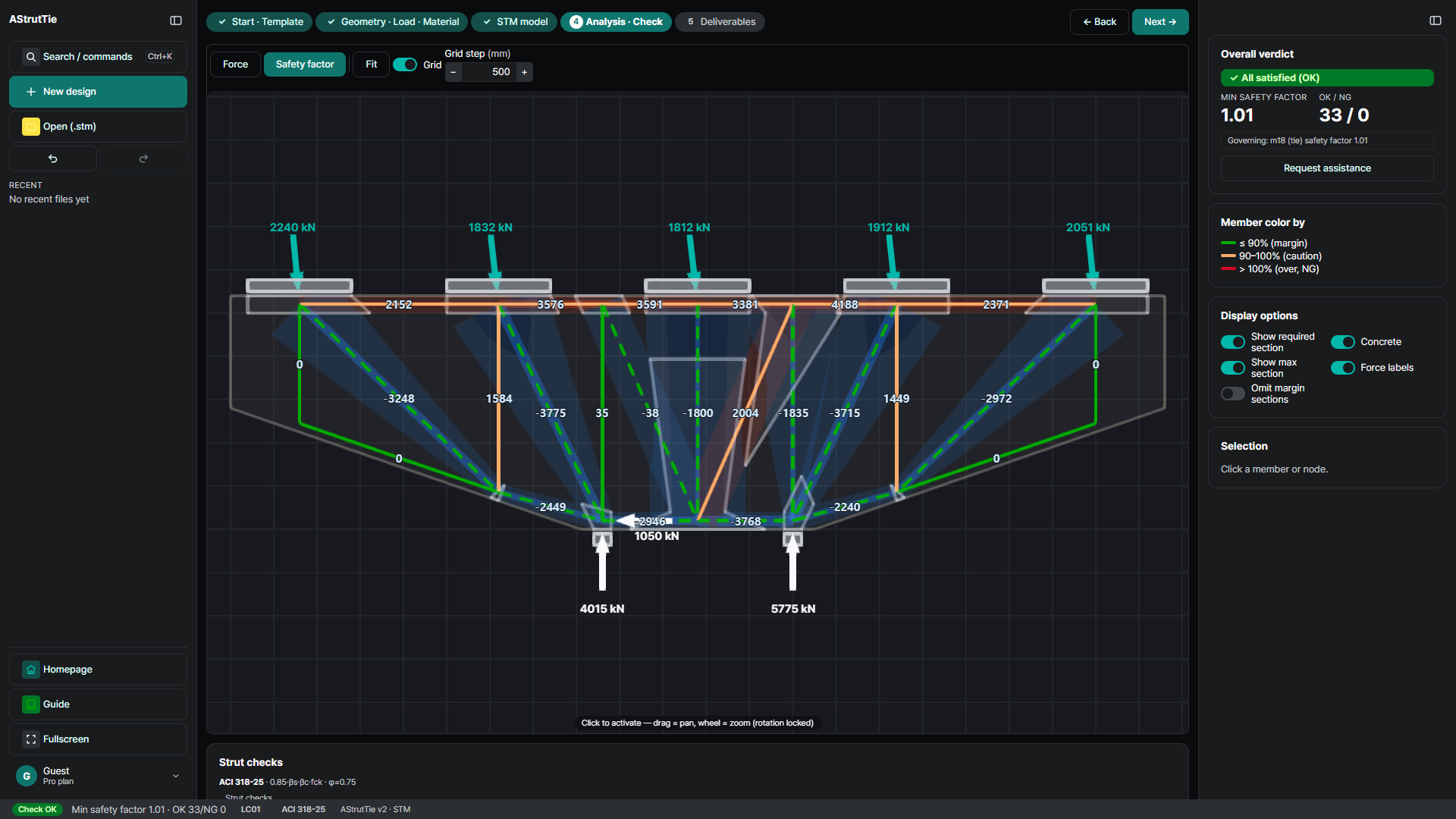
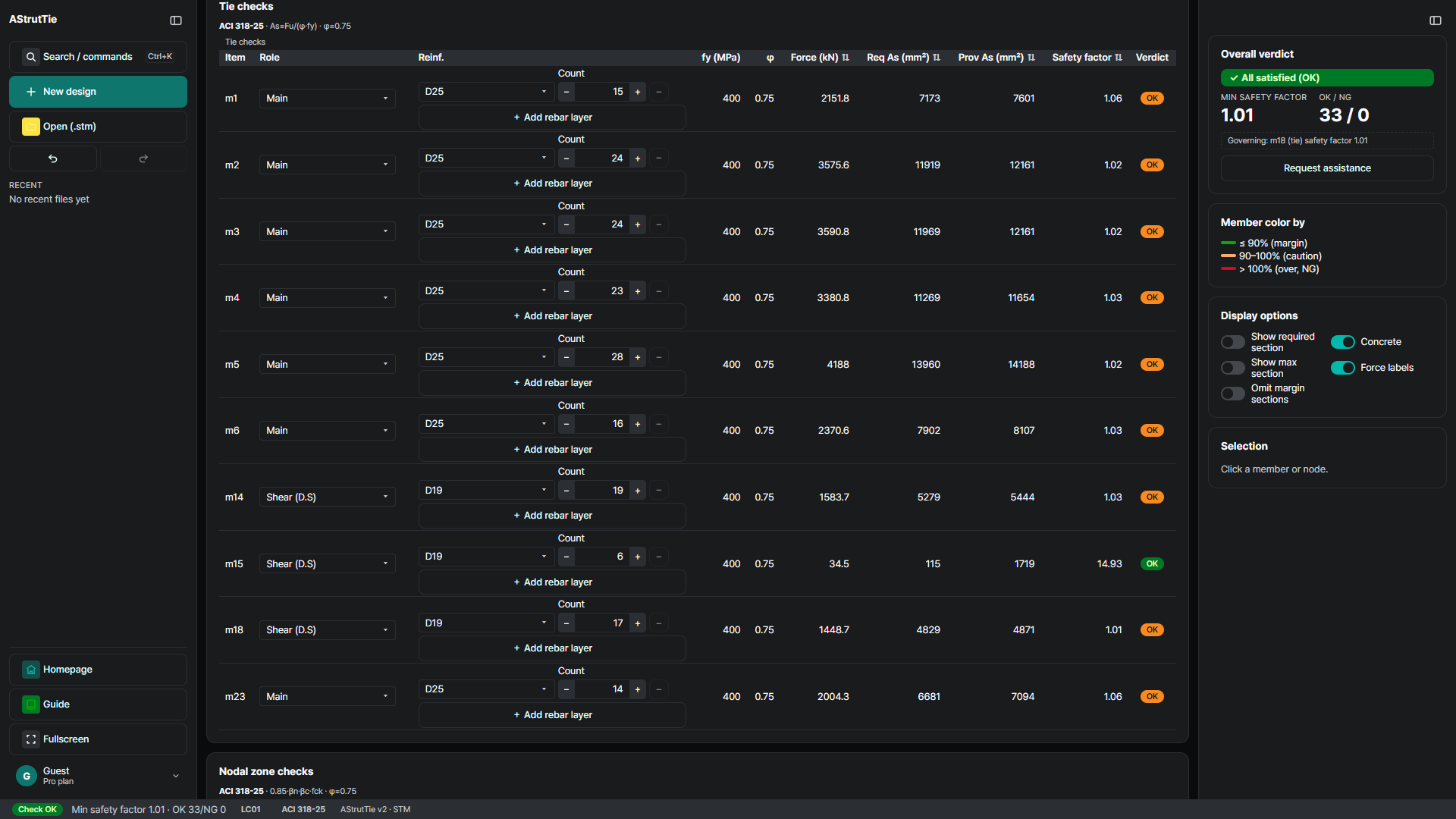
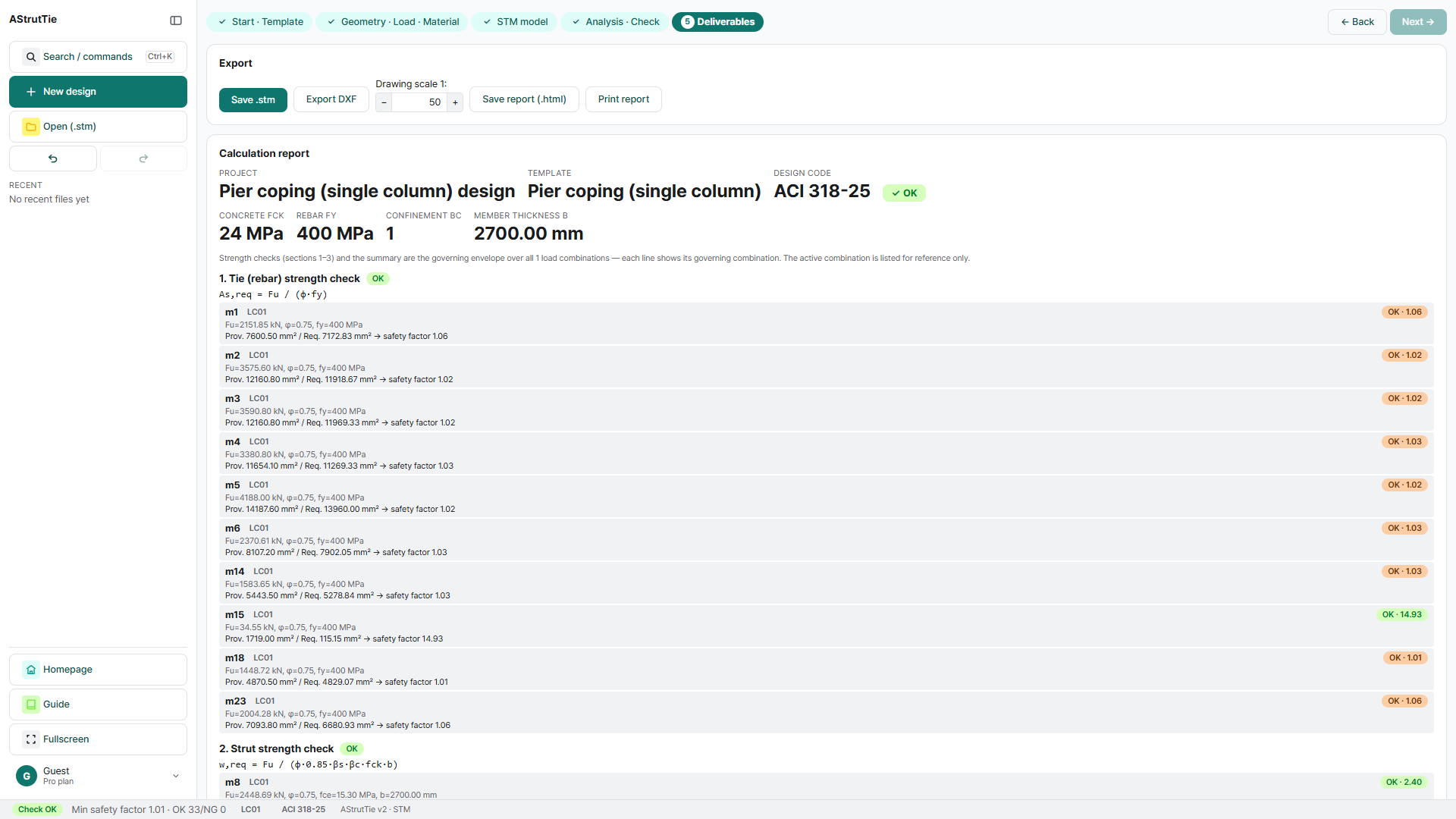
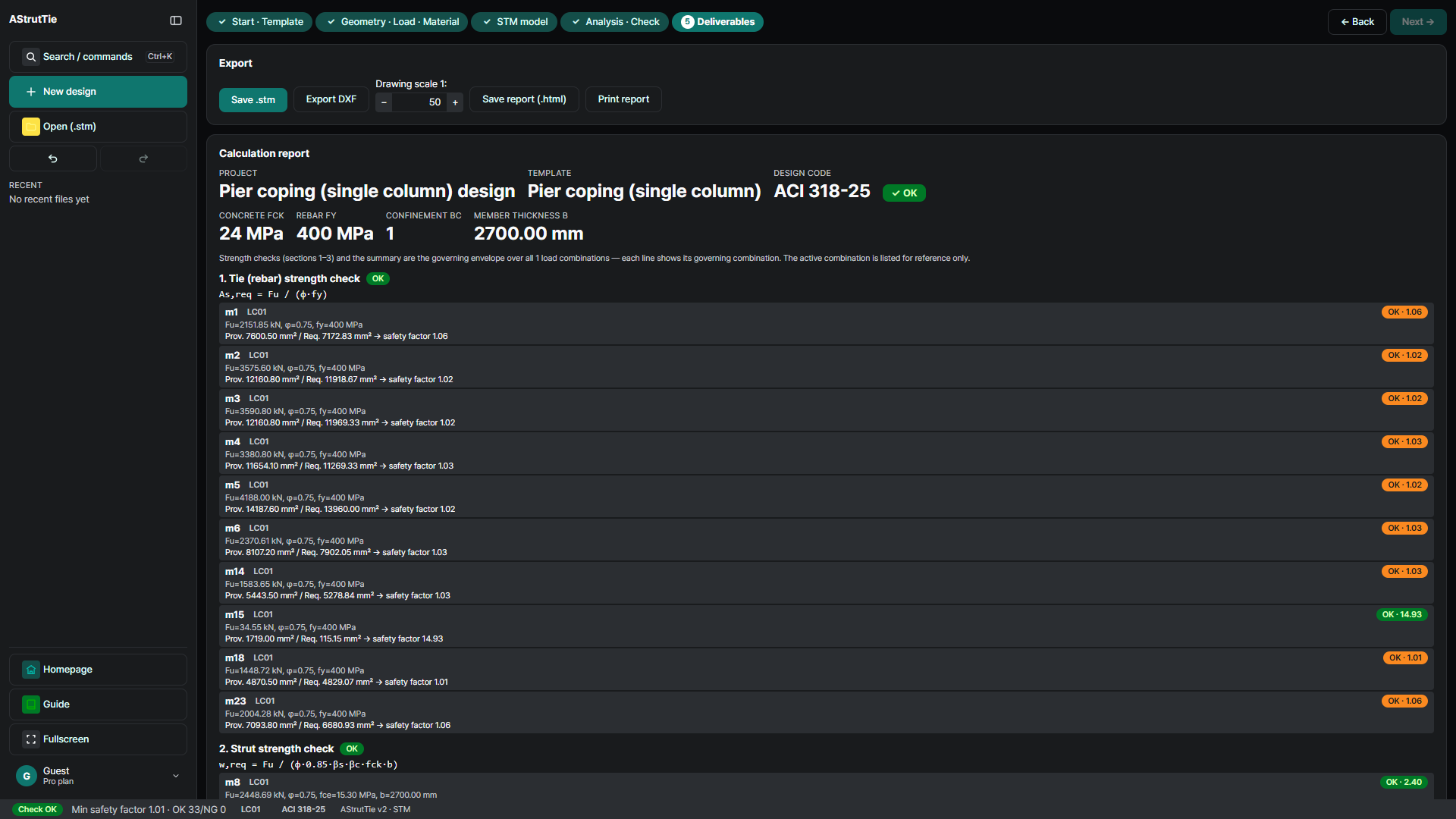
Real AStrutTie screens, in the order you work: build the model, compare it to the stress flow, check it against the code, hand in the report.
What it does
The full strut-and-tie model design workflow, from geometry to a submittable report.
16 D-region templates
Footings (spread, pile, abutment, 3D pile cap, pier/abutment grids), deep beams, continuous deep beams, corbels, pier copings, frame corner, anchor plate, PSC anchorage, box girder, lattice girder — a verified strut-and-tie model in minutes, not hours.
5 design codes
KDS (strength design & limit state), ACI 318, AASHTO LRFD, and Eurocode 2 — strut, tie, and nodal-zone checks with the correct nominal strength for each code.
Truss + plane-solid solvers
Determinate and indeterminate truss analysis, plane-stress FE, principal stress flow, and ESO topology guidance for the model shape.
Reports reviewers accept
Full HTML calculation reports — open in Word or print to PDF — with every check traceable to the code clause.
DXF import
Bring member outlines and truss geometry straight from CAD instead of re-drawing them.
One workspace, web and desktop
The new AStrutTie is one codebase for browser and desktop: a single workspace, a command palette, and one-click auto-fix for failing checks.
AI review assistance — rolling out
A senior-engineer-style reading of the computed results — governing members, NG checks, next steps — in plain language. Every number remains the verified solver's; the AI never recomputes. The judgment and the signature remain the engineer's. Model suggestions are in development.
Rebuilt, not repackaged
AStrutTie has been rebuilt from the ground up: the same verified strength equations, in a modern engine that operates in the browser without installation, and on the desktop from the same code.
- NG one-click auto-fix — envelope and increase-only, never silently unsafe
- Command palette (Ctrl+K) and keyboard-first workflow
- Analysis and design checks run locally via WebAssembly — your model stays in the browser